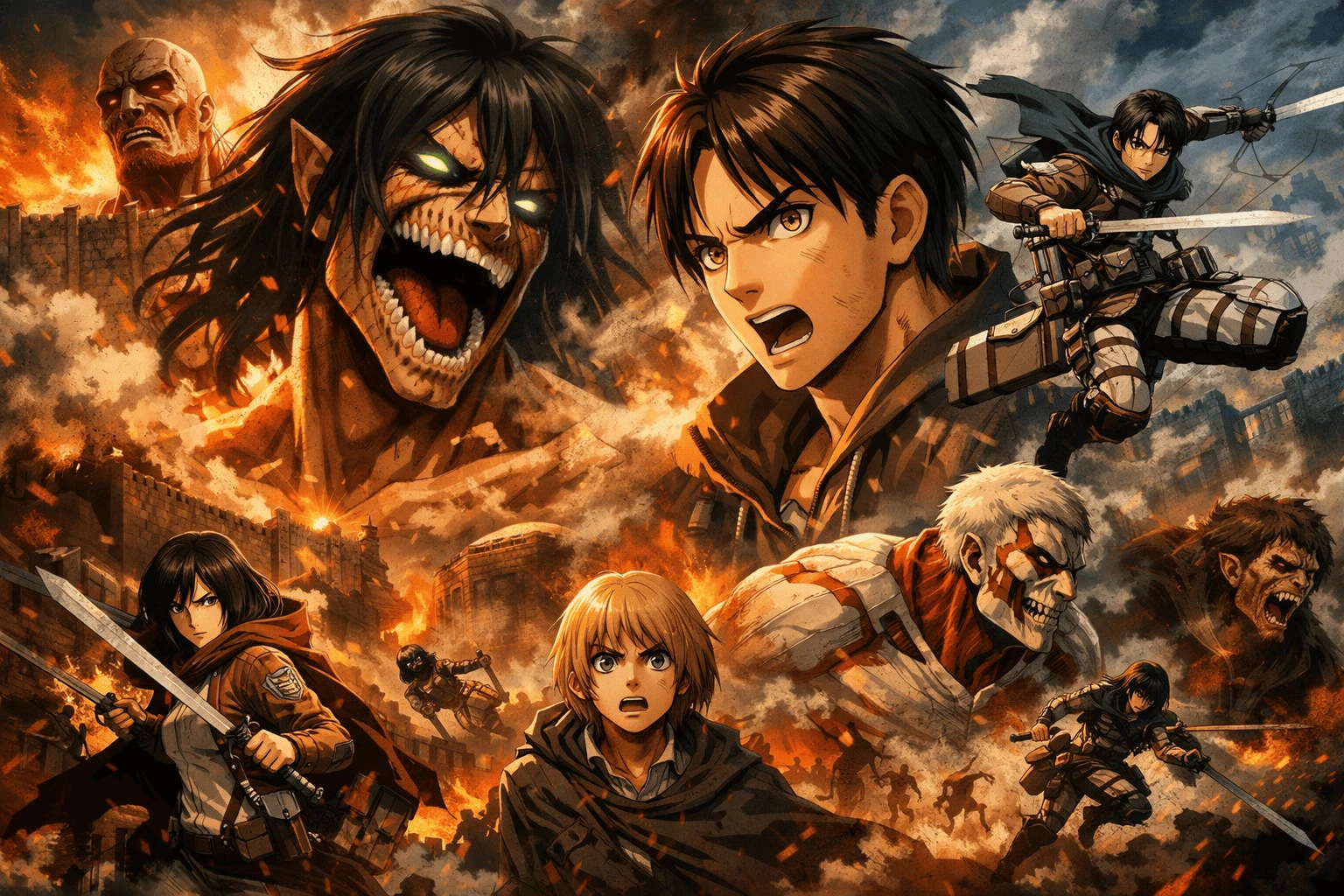
You know the feeling. You are just scrolling peacefully, minding your own business, maybe looking for a funny anime meme or a new seasonal recommendation, and then boom someone is arguing about Eren Yeager again. Someone is posting that one soundtrack clip again. Someone is debating whether the ending was tragic, brilliant, frustrating, or all three at once. Somebody else is rewatching episode one and acting like they discovered emotional damage for the first time.
And somehow, years after the story hit its ending, Attack on Titan still refuses to leave the anime conversation.
That is not normal.
Most series get their big moment, enjoy a wave of hype, and then slowly slide into nostalgia. People remember them fondly, maybe recommend them once in a while, maybe rewatch a favorite arc on a lazy weekend. But Attack on Titan is built differently. It does not simply live in memory. It keeps reappearing in discussion like a titan hand punching through a wall you thought was finally secure.
The truth is, Attack on Titan did not just become popular. It became a shared experience. It became one of those rare stories that anime fans, casual viewers, first-timers, critics, manga readers, dub watchers, and even people who “do not usually watch anime” all somehow had opinions about.
And maybe that is why it still dominates.
Because Attack on Titan was never just a show people consumed.
It was a show people survived.
A Story That Refuses to Be Forgotten
It Started Like a Monster Story, Then Became Something Much Bigger
At the beginning, the pitch sounded almost deceptively simple.
Huge man-eating giants. A walled city. Humanity cornered. A hotheaded protagonist swearing revenge. If you came in blind, you probably expected a dark action series with cool gear, nasty monsters, and a lot of screaming.
And yes, it absolutely had all of that.
But what made Attack on Titan explode wasn’t only the horror or the action. It was the moment viewers realized that the titans were only the beginning.
The series weaponized curiosity better than almost any anime of its generation. Every answer opened three more questions. What are the titans? What is in the basement? Why does the world feel wrong? Why does every victory feel like it costs ten years of your life? Why does every hopeful speech feel like the anime is sharpening a knife behind its back?
It made audiences suspicious of everything.
That suspicion became part of the viewing experience. Fans were not just watching. They were investigating. Screenshots were analyzed like crime evidence. Opening themes were treated like coded prophecy. Manga readers sat in silence like they knew the end of the world was scheduled for next week. Anime-only fans became detectives against their own will.
That level of engagement is hard to kill.
Even now, when people talk about Attack on Titan, they are not only remembering plot points. They are remembering the feeling of being pulled deeper and deeper into a world that kept changing shape. One minute it was survival horror. Then political thriller. Then war drama. Then moral tragedy. Then a brutal conversation about freedom, violence, history, fear, nationalism, revenge, and whether humans are even capable of breaking the cycles they inherit.
That kind of transformation sticks.
A lot of anime are loved for what they do well.
Attack on Titan is still discussed because it kept forcing people to ask what it was really trying to say.

The Characters Were Never Safe, and Neither Were Our Feelings
Another reason the conversation never dies is simple: these characters made people feel too much.
Not cute little “aw, I love this cast” feelings either. I mean the ugly, intense, spiraling kind. The kind where you sit there after an episode and stare at the ceiling like your rent is due emotionally.
Eren is the obvious center of that storm.
He began as one of the clearest revenge-driven protagonists in modern anime. Furious. Loud. Reckless. Easy to understand. You saw his pain, you saw his rage, and for a while, the story let you believe that was enough. But Attack on Titan never stays in the easy version of a person. It keeps digging until the hero stops feeling like a role and starts feeling like a problem.
That is where the real grip begins.
"If you win, you live. If you lose, you die. If you don’t fight, you can’t win!”(Eren)
People still debate Eren because he is not cleanly packaged. He is not designed to leave everybody comfortable. Depending on who you ask, he is a victim, a warning, a revolutionary, a monster, a tragic child, a selfish idiot, or one of the most daring protagonists anime has ever produced. Usually he is all of them in one conversation.
“If someone tries to take my freedom, I won’t hesitate to take theirs.”(Eren)
And then there is Mikasa, whose love and loyalty are so central to the emotional core of the story that people still dissect her choices like scholars defending a thesis. Armin brings the fragile hope that intelligence and empathy can matter in a cruel world. Levi became more than a fan favorite; he became a symbol of endurance itself. Erwin is still one of anime’s greatest examples of leadership wrapped in obsession. Reiner is practically a walking panic attack, and somehow one of the most human people in the entire series.
“This world is cruel… but also very beautiful.”(Mikasa)
Nobody in this story stays one thing for long.
That matters because flat characters fade with the hype cycle. Complicated characters do not. They stay alive in fandom because every rewatch changes them. You notice new cracks. New motives. New contradictions. A line that sounded heroic once feels terrifying later. A betrayal that looked unforgivable suddenly looks inevitable from another angle.
"Give up on your dreams and die.” ( Levi Ackerman)
And that is the secret sauce.
Attack on Titan gives fans enough emotional material to argue forever, and anime fans, bless us, will absolutely do that.

The Story Refused to Give Easy Answers
A lot of popular anime survive on hype.
Attack on Titan survives on discomfort.
That might sound strange, but it is true. The series became unforgettable because it refused the comfort of simple morality. It could have stayed in the lane of “humans good, monsters bad.” That would have been easier. Cleaner. Safer. Way less likely to start discourse fires every few months.
Instead, it chose chaos.
It asked what happens when the enemy has a face. What happens when history itself becomes a weapon. What happens when pain is inherited, when hatred is taught, when children are handed wars they did not create and then blamed for how they survive them..
That is why the ending still gets talked about with so much intensity.
Not because everyone agrees.
“Nothing can suppress a human’s curiosity.” (Hange Zoe)
Because they do not.
Some people see the ending as bold and devastating. Others see it as messy, painful, or emotionally conflicting. Some think that tension is exactly the point. Others think it hurts the landing. But even that disagreement proves the title of your blog. Dominance in anime conversation is not always about universal praise. Sometimes it is about staying impossible to ignore.
And Attack on Titan is impossible to ignore.
You can love the ending, hate it, defend it, question it, reinterpret it, meme it into oblivion, and still end up talking about it again three weeks later like the series has rented space in your frontal lobe.
That is not a sign of failure.
That is a sign of impact.
The Legacy Is Bigger Than the Ending
By now, Attack on Titan has crossed into something larger than ordinary popularity. It has become one of those defining anime titles people use as a reference point. It is part of the vocabulary of modern anime culture.
When fans talk about masterclass plot twists, they bring it up.
When they talk about opening episodes that changed everything, they bring it up.
When they debate morally broken protagonists, they bring it up.
When they discuss adaptations that shaped a decade, they bring it up.
And the industry itself still treats it like a living giant. The franchise’s continued screenings, streaming presence, recognition like Crunchyroll’s Global Impact Award, and the appetite for related events all show that the series is not being remembered quietly; it is still being actively spotlighted.
That is the key difference.
Some anime are classics because people say they are important.
Attack on Titan feels important because people are still actively encountering its weight.

Maybe that is the simplest answer to the question.
Because it never gave us the luxury of being neutral.
It thrilled people. It devastated people. It divided people. It inspired essays, edits, debates, rewatches, breakdowns, memes, and emotional support group-level discussions. It gave anime one of its most recognizable modern identities and then refused to fade politely into the background.
You do not need everyone to agree for a story to remain dominant.
You just need it to matter enough that people keep coming back.
And Attack on Titan matters.
It matters because it understood spectacle, but never relied on spectacle alone. It mattered because beneath the action and horror was a story about fear, freedom, love, cruelty, history, and the terrifying cost of choosing a future. It mattered because its characters felt too raw to forget. It mattered because its questions did not end when the credits rolled.
Most of all, it matters because somewhere right now, someone is starting it for the first time, and somewhere else, somebody who finished it long ago is still thinking about that final ache.
That is legacy.
That is dominance.
And that is why Attack on Titan is still out here, years later, stomping through anime conversations like the walls never fell at all.